



CPA marketing is one of the most lucrative ways to monetize a niche blog or any other traffic source. In this CPA marketing for beginners guide, you'll learn what CPA marketing is, how it works, how it differs from affiliate marketing, which CPA networks to work with, how to get approved, and how to promote CPA offers to bring home the bacon.
This guide is free, and we're confident it's better than many paid CPA products. That said, we can't promise you'll make big money right away. You'll need to learn a lot and apply it immediately.
Once you become a skilled and experienced CPA marketer, you can earn five- to six-figure monthly incomes from CPA networks.
Let us show you how.
What Is CPA Marketing?
CPA stands for Cost Per Action. CPA marketing is generally easier than selling products, because you get paid when a visitor completes a specific action, not only when they buy something.
The action can be submitting an email, filling out a form, downloading an app, entering a PIN code or mobile number, or making a purchase. When the action is a lead (like a sign-up), it's also called Pay Per Lead (PPL).
People are much more willing to sign up for something free than to spend their hard-earned money. That's why driving your traffic to complete a simple task can turn into cash. Typical payouts range from $0.50 to $20 per action, while some high-end CPA offers pay $750 or more.
Sounds good? That's exactly why we created this guide.
How Does CPA Marketing Work?
CPA networks manage the whole process. Advertisers (the companies behind the offers) submit their offers to CPA networks, which then make them available to publishers like you.
The network pays you a fixed amount for each completed action, based on what the advertiser pays the network.
Your job is straightforward: apply to a CPA network, get approved, browse the available offers, pick the ones that suit your audience, and promote them to targeted visitors as effectively as possible.
CPA Marketing vs. Affiliate Marketing
CPA marketing is a type of affiliate marketing, but there are a few key differences:
- What you get paid for: classic affiliate programs usually pay a commission on sales, while CPA offers pay for many kinds of actions, including free sign-ups, leads, and app installs.
- Who you work with: With affiliate marketing, you often join individual brand programs (like Amazon Associates). In contrast, CPA marketing usually goes through networks that bundle thousands of offers from many advertisers.
- How you promote: affiliate marketing leans on content and SEO, while CPA marketing is often paired with paid traffic, such as native, push, pop, social, or search ads.
CPA Network Terminology
CPA terminology isn't complicated, but you should know these key terms before you launch:
- Advertiser and publisher: Advertisers pay CPA networks to drive conversions for their offers. Publishers (affiliates) are people like you and me who promote those offers to earn money.
- Affiliate manager: The person at the network who manages your account. They recruit and support affiliates and help them grow their revenue.
- Category / vertical: The niche an offer belongs to (sweepstakes, finance, dating, health, gaming, etc.).
- Chargeback: When a conversion is reversed, for example because a sale fell through or an item was returned. The commission you were credited for it is deducted from your earnings.
- Commission/payout: The flat amount or percentage you earn for each successful conversion. Always check the payout before choosing an offer.
- Contextual link: A text link placed within your content that points to the offer.
- Conversion rate (CR): The percentage of visitors who complete the action, calculated as conversions divided by clicks, times 100. For example, an offer with 500 clicks and 70 leads has a conversion rate of (70 / 500) × 100 = 14%. Offers with higher conversion rates are usually preferable.
- Cookies: Small files that tag users who click your affiliate link, so you get credit if they convert within a set window, typically 30 to 90 days.
- EPC (earnings per click): The average amount publishers earn per click on an offer. It doesn't mean you're paid per click. For example, a $2.50 offer that gets 500 clicks and 70 leads has an EPC of ($2.50 × 70) / 500 = $0.35.
- GEO/country targeting: Most CPA offers only accept traffic from specific countries. If you send Australian visitors to a US-only offer, you won't get paid. Networks list the allowed countries (US, UK, AU, BR, etc.) with each offer.
- Incentive vs. non-incentive: Incentive offers let you reward users (with points, coupons, virtual currency, or cash) for completing the action. Non-incentive offers strictly forbid any reward. Breaking this rule is one of the fastest ways to get banned.
- Offer page/landing page: The page where the conversion happens.
- Offer type: The kind of action required, such as PIN submission, email submission, download, survey, app install, or purchase.
- ROI (return on investment): How profitable a campaign is: (revenue − ad spend) / ad spend × 100. If you spend $100 and earn $150, your ROI is 50%.
Now that you know the essential terminology, let's look at the pros and cons of CPA marketing.
CPA Marketing Pros and Cons
CPA Marketing Pros
- Unlike classic affiliate marketing, you can get paid without generating sales.
- High payouts are possible, such as $100+ for a casino depositor or a crypto exchange sign-up
- There are CPA offers in almost every niche you can think of
- You can start with little to no upfront investment
CPA Marketing Cons
- As a beginner, getting accepted into top CPA networks isn't easy
- Many of the best-paying offers only accept Tier 1 traffic (US, UK, CA, AU, etc.)
- It's competitive, so you need to be creative to make good money
What Are the Best CPA Networks?
The best CPA network for you depends on your traffic source and experience. Here are 10 well-known CPA networks to consider:
Top 10 CPA networks
- MaxBounty (recommended for experienced marketers)
- Perform[cb], formerly Clickbooth (recommended for experienced marketers)
- AdWorkMedia (recommended for all levels)
- CPALead (recommended for beginners)
- Adscend Media
- MGCash (recommended for beginners)
- CrakRevenue
- ClickDealer
- CPAGrip (recommended for beginners)
- AdGate Media
There's a good reason to start with the networks we recommend for beginners. Top networks like MaxBounty have strict rules about traffic and promotion methods.
For example, some offers can't be promoted on giveaway sites, and some ads can't use words like "Free," "Win," or "Claim." If you break these rules repeatedly, you may get banned and lose your earnings.
CPALead, on the other hand, is far more flexible: it accepts incentive traffic and many promotion methods other networks don't. That's why we tagged the beginner-friendly networks above.
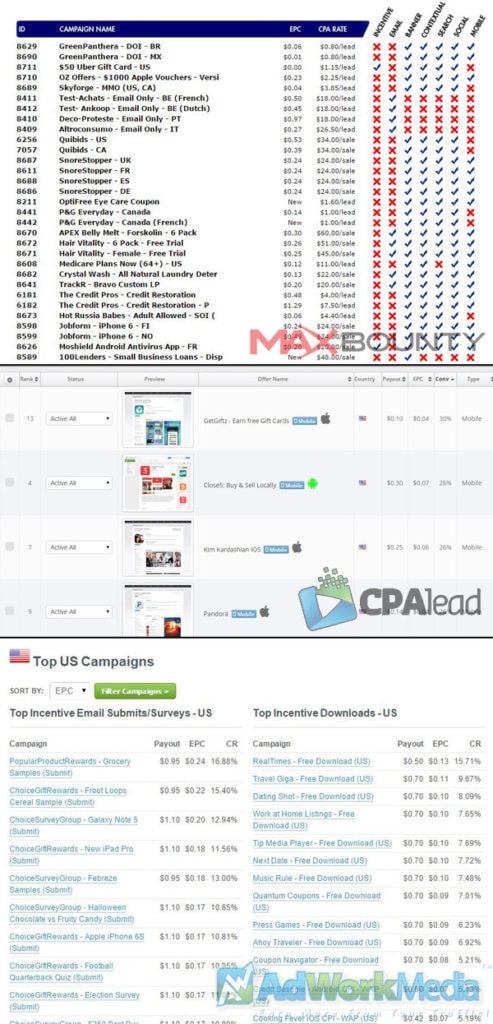
Here's a look inside the offer dashboards of some of the CPA networks we've worked with:
To stay up to date on CPA marketing and improve your skills, join a community. You're already in one: TopGold.forum has dedicated affiliate marketing boards where you can ask questions and share results. Warrior Forum and AffiliateFix are also worth joining.
Know a great CPA network we missed? Share it in the replies, along with your experience with any network you've worked with.
How to Get Approved by CPA Networks
The first problem most newbies face is getting approved by the top CPA networks. Here's our advice:
If you're new to CPA marketing, don't start by applying to the industry's top networks, such as MaxBounty. These networks often approve accounts only after a phone interview, expect prior experience, and enforce strict promotion rules.
So, what should you do?
Start with a newbie-friendly CPA network.
How much can you make with beginner-friendly networks?
It depends on your skills and experience. Some expert CPA marketers make $3,000+ per day even with newbie-friendly networks.
Here are some beginner-friendly, reliable CPA networks with fast approval. Don't rely on just one: get approved by at least three, so you can compare offers, payouts, and conversion rates. That will help you a lot in the long run.
Beginner-friendly CPA networks
First, apply to 2–3 networks and gain experience. Then move on to the leading CPA networks for bigger results.
Step-by-step: applying to CPA networks
Let's start with AdWorkMedia and CPALead. Below is a screenshot of the CPALead sign-up form. Almost every CPA network asks for similar information when you apply for a publisher account.
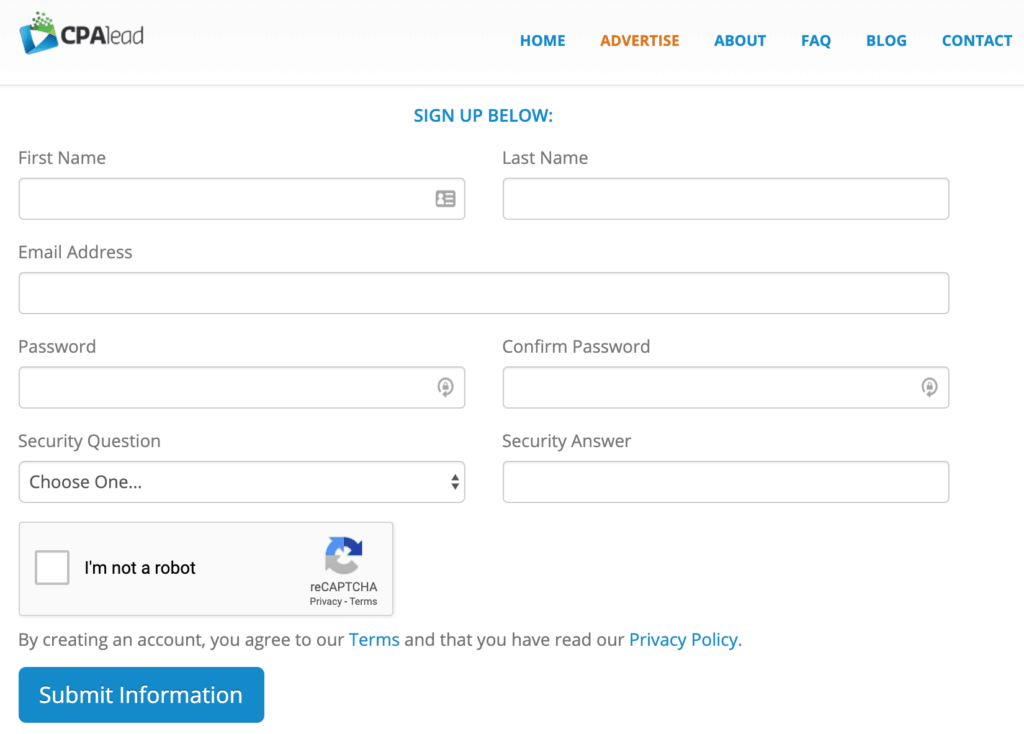
Most CPA networks require an established website or other media you'll use to promote their offers.
If you're stuck because you don't have an established website, don't worry: CPALead doesn't require one, so start there. If you do have a good website, AdWorkMedia is highly recommended.
Step 1: Fill in your details
Go to the AdWorkMedia and CPALead sign-up pages and fill in your name and personal details. If possible, use a professional email address on your own domain (e.g., [email protected]) to improve your chances of approval. If you don't have one, a regular Gmail or Outlook address is fine.
Step 2: Describe your promotional methods
The promotional methods section is the most important part of your application. A few tips:
- Choose the methods you'll actually use, such as website, PPC, or social media. Select all that genuinely apply.
- Never list someone else's website as yours. Networks check, and you'll get caught.
- Select the traffic type honestly (incentive or non-incentive). Misrepresenting your traffic is a common reason for bans and withheld payments.
- In the description, explain how you'll drive traffic, for example: PPC campaigns, Facebook ads, native ads, content marketing, SEO, or display networks.
Step 3: Contact your affiliate manager (top networks only)
After you submit your application, you're done with beginner-friendly networks. Top networks, however, usually approve accounts after a phone interview: you'll receive an email saying your application is under review.
Don't just wait. Contact your affiliate manager as soon as possible (their details are usually in that first email):
- Call them by phone, if a number is provided
- Or message them on Telegram, WhatsApp, or whichever messenger they list
- Or send an email saying you've just applied for a publisher account and are ready for the interview
This simple step makes a great first impression. It shows you're serious about the account, which is a strong signal for fast approval.
How to Promote CPA Offers
We've written a detailed guide on promoting CPA offers, covering 100+ ways to make a profit. Here are the main strategies:
- Share offers in relevant groups and communities on social networks like Facebook, Reddit, LinkedIn, and Telegram (always follow each community's rules)
- Create videos on YouTube, TikTok, or Instagram Reels and convert viewers into leads
- Write high-quality content and distribute it through your own blog, guest posts, and platforms like Medium
- If your blog matches a network's offers, use it to drive conversions directly
- Build an email list for high-quality, repeatable leads. GetResponse is a good, affordable option
- Build a dedicated site around a specific CPA offer and rank it in search for ongoing leads
- Buy banner, native, push, or pop ads to promote offers without your own site
- Run Facebook, Google, or Microsoft Ads campaigns, which can be very profitable with the right offers
How Do CPA Networks Pay You?
Most CPA networks support several payment methods. PayPal and bank transfers are the most widespread, but many also pay via Payoneer, Skrill, crypto (BTC or USDT), or check.
We recommend opening a Payoneer account: it gives you local receiving accounts in USD and other currencies so networks can pay you like a local business, plus a Mastercard you can use at ATMs worldwide. For a full comparison, read our guide to the best payment methods for affiliate marketers.
Conclusion
There you have it: a complete guide to CPA marketing for beginners. Now it's time to set your goals and start working.
Want to go deeper? Check out our list of the 10 best CPA marketing courses and pick one that fits your needs.
If you're on the other side of the fence, we also have a detailed guide to CPA marketing for e-commerce business owners.
Still have questions about CPA marketing? Ask in the replies below. The community and the TGF team will do their best to answer every one.








Recommended Comments
There are no comments to display.
Create an account or sign in to comment
You need to be a member in order to leave a comment
Create an account
Sign up for a new account in our community. It's easy!
Register a new accountSign in
Already have an account? Sign in here.
Sign In Now