In this native advertising guide, you'll learn what native advertising is, what native ads look like, the best native advertising networks, and how to make it work for you by launching and managing campaigns.
Native advertising lets you offer visitors relevant content at the right time. Gone are the days of chasing users down and forcing them to sit through ads that may or may not be relevant.
This guide is free, and we're confident it's more useful than many paid products. Once you have some skill and experience, native advertising can deliver great results.
Let's get started!
1. What Is Native Advertising?
Native advertising is an online marketing method that uses paid ads designed to match the look of the website they appear on and blend into the surrounding content.
It lets you target a highly relevant audience and show your content to people interested in your product or service. When native ads are done well, users don't mind them, because they feel authentic and non-intrusive.
You see native ads every time you browse the internet, often without even noticing: in your social media feeds, on your favorite blogs, and on YouTube.
When people talk about native advertising, they usually mean the content recommendations you see across websites, especially blogs and news sites. However, in-feed ads, promoted listings, and paid search ads are also forms of native advertising.
The secret of native advertising is that it's non-disruptive: it exposes users to advertising content without forcing it on them.
2. Native Advertising Statistics
According to Sharethrough research, native ads drive more attention and brand lift than traditional display ads.
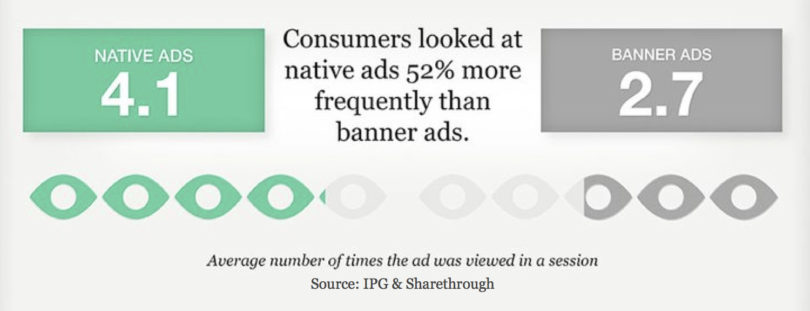
2.1 Native advertising performance stats (Sharethrough)
- Consumers looked at native ads 53% more often than display ads.
- 25% more consumers viewed in-feed native placements than display ad units.
- Native ads delivered an 18% higher lift in purchase intent and a 9% lift in brand affinity compared to banner ads.
- 32% of respondents said a native ad "is an ad I would share with a friend or family member," versus just 19% for display ads.
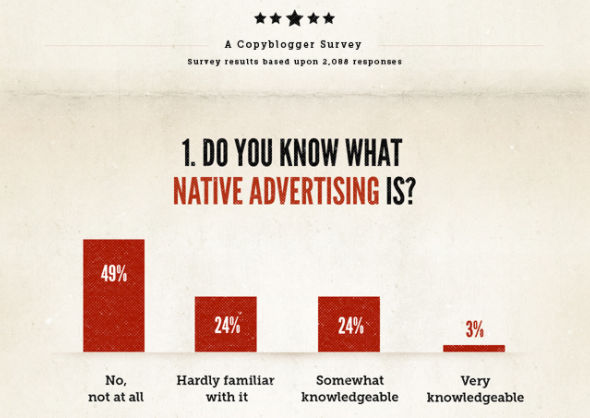
Not all the stats are positive, though. An early Copyblogger survey on the state of native advertising showed some of the challenges publishers and advertisers faced as the format grew:
2.2 Native advertising acceptance stats (Copyblogger)
- 49% of consumers didn't know what native advertising was.
- 51% of consumers were skeptical about native advertising.
- 41% of publishers offered native advertising as an option.
- Only 19% of publishers said their work consisted of native advertising.
These contrasting stats make native advertising a little controversial. Still, advertisers love native ads because their click-through rates are typically much higher than regular display ads, and engagement is usually much stronger.
Now that you have a basic understanding of native advertising, let's cover some technical terms you'll need when we discuss native ad networks and best practices.
3. Basic Native Ads Terminology
- Native advertising: Paid ads that match the look, feel, and function of the media format where they appear. Unlike banner ads, native ads don't look like ads; they look like part of the page's editorial flow.
- Ad network: An intermediary that connects advertisers with websites that host ads and coordinates ad campaigns.
- Bid: The maximum amount an advertiser is willing to pay for an ad impression or click, depending on the bidding model.
- Content recommendations: Content such as blog posts, news articles, or landing pages suggested to users on the site they're visiting.
- Content discovery platform: A platform that displays sponsored content in widgets below or beside editorial content on publisher websites, using algorithms to deliver personalized recommendations to each reader.
- CPC bidding: Cost per click. The advertiser pays for each click on the ad. The final price is set in an auction but won't exceed your bid.
- CPM bidding: Cost per mille (cost per thousand impressions). The advertiser pays for every 1,000 ad impressions.
4. Types of Native Advertising (with Examples)
The Interactive Advertising Bureau (IAB), the main organization that sets ad industry standards, published a report defining six categories of native ads. But no single classification exists because native formats keep evolving. Here are the major types:
4.1 In-feed native ads
In-feed native ads appear in social media feeds like Facebook, Instagram, or X, as well as on publisher sites and news aggregators.

Common disclosure labels for in-feed ads include:
- "Ad" or "Sponsored" on Google and YouTube
- "Promoted" or "Ad" on X (Twitter)
- "Sponsored" or "Promoted" on LinkedIn and Yahoo
- "Presented by [brand]" or "Partner content" on publishers like BuzzFeed and HuffPost
- "Sponsored" on Facebook and Instagram
4.2 Search ads
Search ads appear in search results, usually above or below the organic results, in placements sold to advertisers. They look almost identical to organic results, apart from the "Sponsored" or "Ad" label.
4.3 Promoted listings
Promoted listings are ads that appear in search results on e-commerce sites, usually, but not always, at the top.
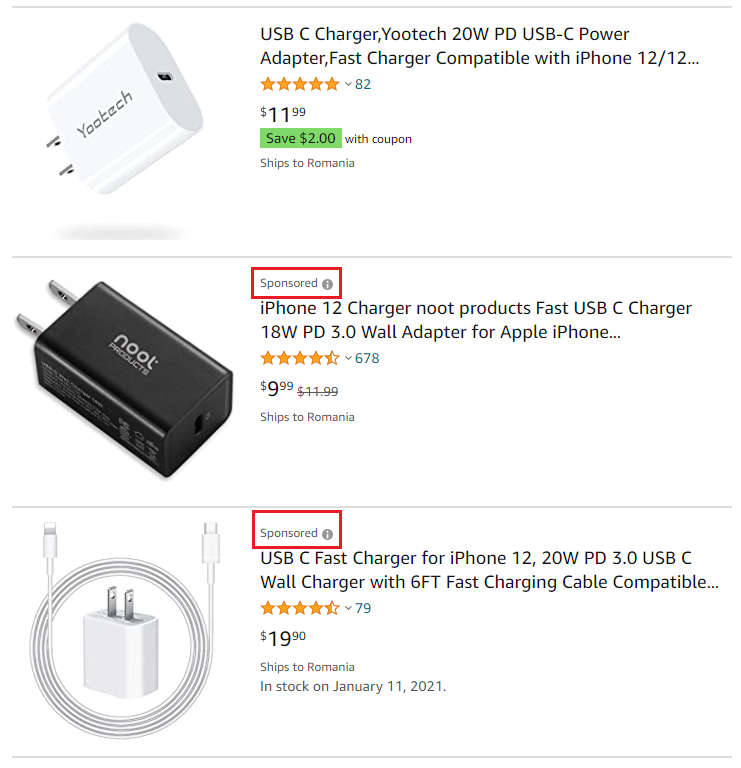
Common disclosure labels for promoted listings:
- Sponsored
- Sponsored listing
- Promoted
4.4 Content recommendation widgets
Content recommendations remain one of the dominant native ad formats. These are the widgets you see below or next to articles on publisher websites. They're non-intrusive and don't disrupt the user experience.
Recommendation widgets often appear on premium websites like The Guardian, HuffPost, NBC News, CNN, and The Telegraph.
To show the most relevant recommendations, content discovery platforms like Taboola and Teads (formerly Outbrain) match each reader's profile against the targeting options advertisers set, and customize the widget for every user. Today, these platforms offer advertisers many targeting options to reach the right people at the right time.
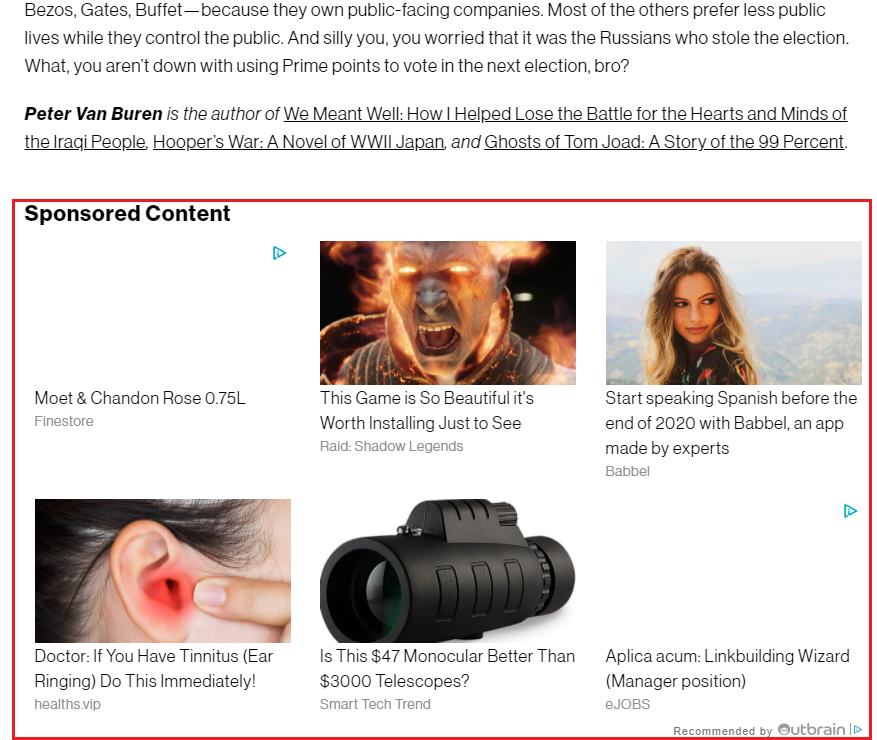
Content recommendation widgets usually include up to three disclosure signals:
- A section heading like "You might also like," "From around the web," "You may have missed," or "Recommended for you."
- The sponsor's or landing site's name shown after the visual and headline, sometimes with a note that the unit mixes publisher and third-party content.
- The third party's company name or logo, indicating the content isn't from the publisher.
4.5 Custom content units
Advertisers and publishers can also create custom native ads together, and the possibilities are almost unlimited. Custom units cover formats that don't fit the categories above, or that are too platform-specific to be a category of their own (like sponsored playlists), but still belong on a marketer's radar.
4.6 Sponsored articles
Media companies, large and small, offer sponsored articles, often through branded content programs like Forbes' BrandVoice. They're designed to feel like ongoing thought leadership rather than one-off promotions.
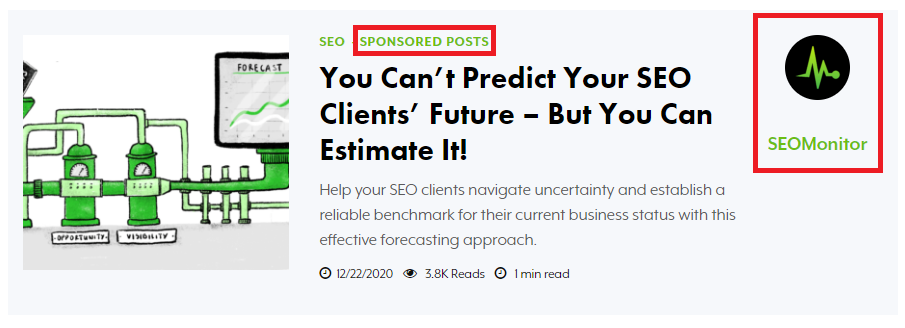
With sponsored articles, you reach a new audience in a format they already enjoy, borrow the publisher's brand and trust, and generate sales and exposure, all while educating readers in a non-intrusive way.
5. Native Ads Pros and Cons
Native advertising pros
- Better audience targeting
- Often cheaper than search and social ads
- Reaches users who've become "blind" to banner ads
- Less affected by ad blockers than traditional banners
- Done right, it can enhance the content experience
Native advertising cons
- Can feel deceptive to visitors if poorly labeled
- Low-quality widgets can hurt publishers' reputation and traffic
- Google may penalize sponsored content that isn't properly marked
A quick note on Google penalties: Google is against deceptive and intrusive ads and doesn't allow sponsored content without proper markup (for example, rel="sponsored" on paid links). If you follow Google's rules on sponsored content and the FTC's native advertising guidance (clearly label ads and don't overload pages with them), you should be safe.
6. Native Advertising Goals
6.1 Build brand awareness
Brand awareness is about establishing a strong online presence. Many brands use native advertising to place their articles and videos on the world's most popular websites and reach wide but highly relevant audiences.
6.2 Attract leads
Native advertising has proven very effective for performance marketing goals. It helps you attract leads by getting readers to take specific actions, such as downloading an app, signing up for a newsletter, or requesting a quote.
6.3 Drive sales
Advertisers use native ads to drive direct sales less often than for awareness or engagement, but native can still contribute a lot to sales. Since people rarely buy the first time they see your content, sales campaigns work best when you target warm audiences, such as by retargeting website visitors.
6.4 Strengthen customer loyalty
Native advertising is also a chance to build trust and loyalty. Because of their format, native ads don't have to make a hard pitch. Customers appreciate content that provides real value.
7. Native Advertising Challenges
7.1 Native advertising takes time
Native advertising is powerful, but you have to do it right to unlock its potential. To get attention and convert visitors, your ads need to stand out from the crowd, and without experience, that takes time and testing.
7.2 Choosing between many options isn't easy
For search ads, you go to Google Ads. For social, you go to Meta. But which native network should you pick? How many should you use? Is one better for your industry? There are plenty of native ad companies, which makes the choice harder.
7.3 Measuring performance can be tricky
Is native advertising working for you? Which metrics should you track? Measuring ROI is still a challenge for many brands, especially when you're running several campaigns across networks. Use proper conversion tracking (a pixel or postback) from day one.
Now let's look at some of the best native advertising networks you can use to promote your content and offers.
8. Top 6 Native Advertising Platforms
Many native ad networks can help. Here are six of the best for generating traffic, leads, and sales.
1. AdStyle

AdStyle specs:
- Founded: 2015
- Reach: 40+ billion monthly ad impressions in 65+ countries
- Minimum budget: From $500
- Ad formats: Native, in-content, banner, on-scroll, discover
AdStyle is a native advertising and content discovery network that brings together a wide range of online marketing and publishing resources. Its goal is to provide a dynamic content marketplace and a community of satisfied advertisers and premium publishers worldwide. It also offers both advertiser and publisher tools under the same dashboard, which is handy if you do both.
AdStyle pros
- Quality publishers in 40+ languages
- You can start with $500
- Auto-optimization powered by a self-learning algorithm
- Retargeting tools available
- Great customer service
AdStyle cons
- Targeting is limited, so you rely more on the algorithm
- Limited details about traffic volume per device and country
- Limited payment options, with no crypto
→ Visit AdStyle and start advertising
2. Taboola
Taboola specs:
- Founded: 2007
- Reach: Hundreds of millions of daily active users across top publisher sites.
- Minimum budget: Self-serve campaigns from about $10 per day
- Ad specs: find them here
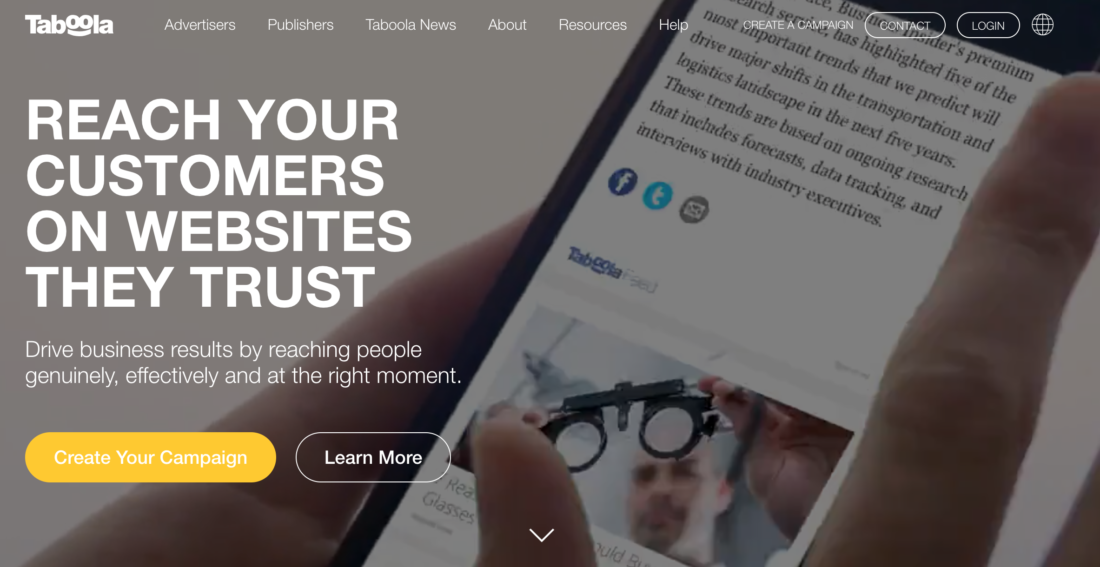
Taboola is one of the world's leading content discovery and native advertising platforms. It recommends content across top websites like NBC News, Daily Mail, The Weather Channel, Eurosport, and Yahoo! Japan.
The platform gives you full control over your campaigns, from setting goals to adjusting daily delivery while a campaign is live. You can target by location, device, operating system, and connection type, among other options.
Taboola pros
- Many high-quality publishers like CNN, NBC News, and MSN
- Cost-effective compared to Google and Facebook
- Easy-to-use interface
- Great customer service
Taboola cons
- Limited site-level allowlisting makes it harder to zero in on the best traffic
- No easy way to block sites in bulk
- Creative approval can be slow, with vague reasons for rejections
https://www.youtube.com/watch?v=mV4mZZQbCQ0
3. Teads (formerly Outbrain)
Teads specs:
- Founded: 2006 (as Outbrain)
- Reach: Over 2 billion consumers across premium publishers
- Minimum budget: Self-serve campaigns from about $10 per day
- Ad guidelines: find them here
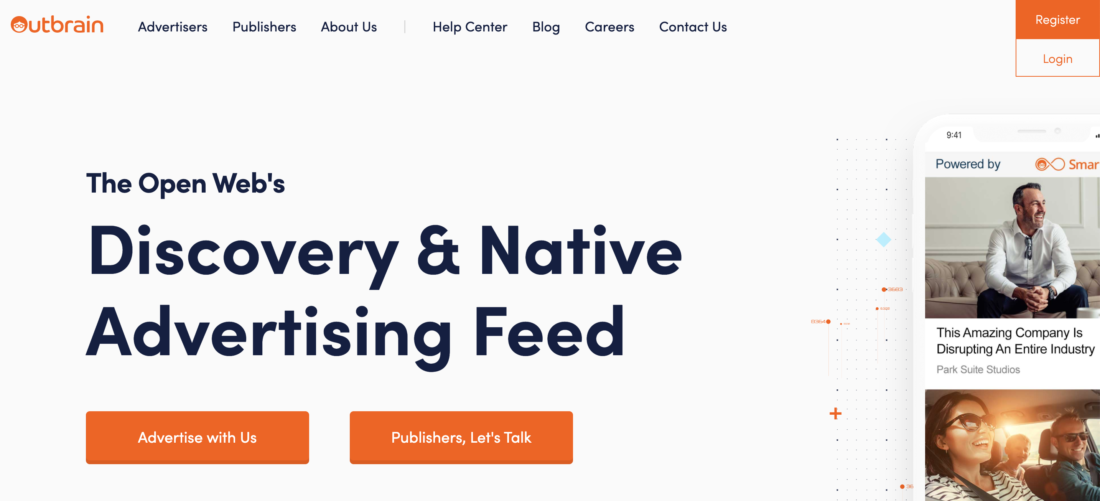
Outbrain is the other giant of content discovery, displaying recommendation widgets on publishers like CNN, Fox News, The Telegraph, The Guardian, and Mashable. In February 2025, Outbrain acquired the ad platform Teads and now operates under the Teads brand, combining native performance ads with Teads' branding and video formats.
Its ad approval process is rigorous for both advertisers and publishers, so your ads need to be high-quality and well-crafted to get approved.
Teads (Outbrain) pros
- Custom targeting options
- Access to quality publishers like CNN, Time, and ESPN
- Cost-effective compared to Google and Facebook
- Easy-to-use interface
- Great customer service
Teads (Outbrain) cons
- Limited site-level allowlisting makes it harder to zero in on the best traffic
- No easy way to block sites in bulk
- Hard to get approved at the beginning
- Creative approval can be slow
4. MGID
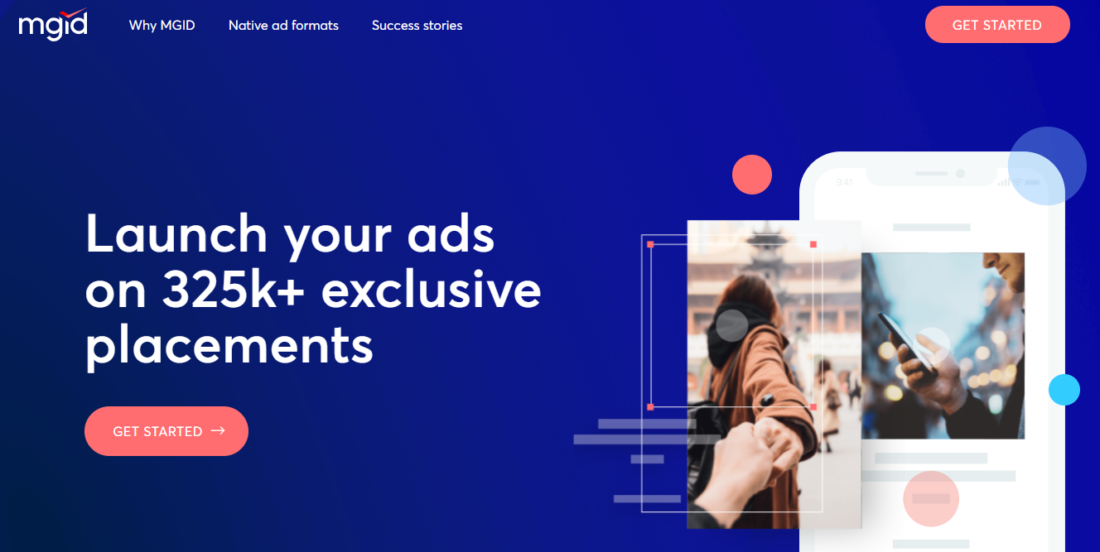
MGID specs:
- Founded: 2008
- Reach: Well over 100 billion impressions per month
- Minimum budget: From $100 (higher for a dedicated account manager)
- Ad specs: find them here
MGID partners with tens of thousands of publishers worldwide, letting advertisers drive high volumes of diverse traffic from Europe, the US, Asia-Pacific, Canada, and beyond. It's one of the most popular native networks among affiliates.
Dynamic retargeting is available. Instead of interest-based targeting, MGID makes sure ads reach relevant audiences by requiring you to select a category for every offer you promote.
MGID pros
- You can start advertising with only $100
- Lots of control over campaign management
- One of the oldest native ad networks
- Dynamic retargeting
- Great customer service, including an account manager at higher budgets
MGID cons
- The dashboard can feel overwhelming for beginners
- Bounce rates can be higher than on other networks
- Creative approval can be slow
5. Revcontent
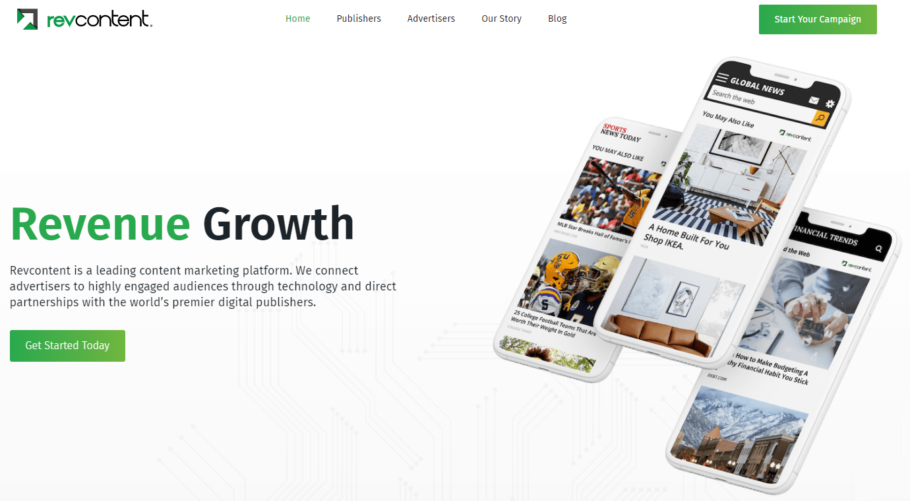
Revcontent specs:
- Founded: 2013
- Reach: Billions of content recommendations per month, mostly Tier 1 traffic.
- Minimum budget: From $100
- Ad specs: find them here
Revcontent has built a reputation as a fast-growing native advertising platform with strict quality requirements for both publishers and advertisers. Thanks to those standards, most of its traffic comes from Tier 1 countries like the US and UK.
Revcontent pros
- You can start advertising with $100
- Lots of control over campaign management
- Real-time performance metrics by device, site section, and content
- Dynamic retargeting
- Proprietary algorithms promote your most engaging content to boost page views
Revcontent cons
- Minimum daily budget of $100
- Strict approval for creatives and landing pages
- Creative approval can be slow
6. AdNow
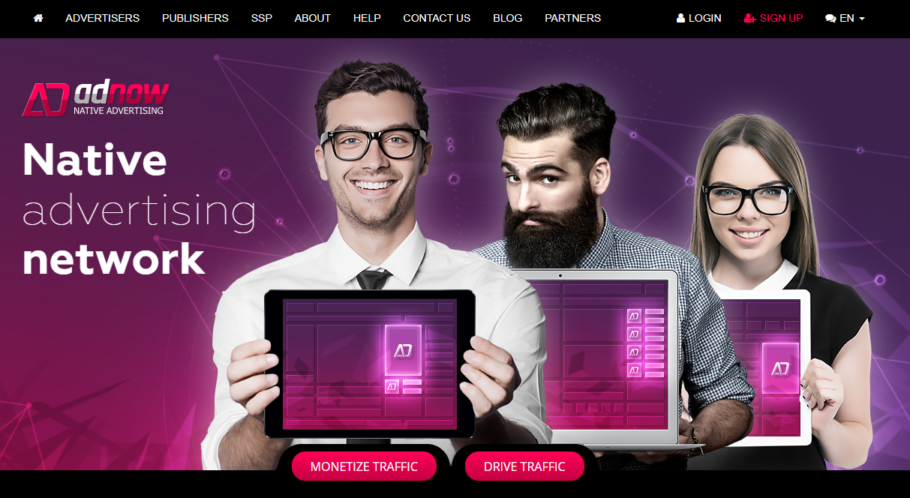
AdNow specs:
- Founded: 2014
- Reach: 160,000+ publishers in over 100 countries
- Minimum deposit: $30
- Ad specs: find them here
AdNow is a native ad network with a huge publisher base across Europe, Asia, Africa, and Latin America. It's smaller than Taboola or MGID in volume, but it's very beginner-friendly and has one of the lowest entry points in the industry.
It supports CPC and CPM buying, with native widgets, banners, and hybrid ads that combine both formats in a single campaign.
AdNow pros
- Lets you advertise on non-English sites
- Access to smaller, niche publishers you won't find on other networks
- Advanced targeting options
- Fast support
- Low $30 minimum deposit
AdNow cons
- Lower traffic volume than the biggest networks
- Some publishers are of questionable quality, so monitor your placements
Want to know more? Read our AdNow review or sign up for an account.
9. How to Choose a Native Advertising Platform
When choosing a native ad platform, consider your goals, budget, the type of content or offer you promote, and the kind of traffic you need.
Here are the key factors to consider:
Setup and approval
Check how easy it is to get started. Some networks approve self-serve accounts in minutes, while others manually review every advertiser, campaign, and landing page, which can slow your launch.
Pricing model and minimums
Make sure the pricing fits your budget. Most native networks use CPC; some offer CPM or conversion-based bidding, and minimum deposits range from about $30 to $500 or more.
Traffic quality
Traffic quality varies a lot between networks and even between publishers on the same network. Track your results per site (by placement or widget ID) and block the sources that don't convert.
Network requirements
Review each network's content policies before you sign up. Some verticals, like nutra, crypto, gambling, or adult, are restricted or banned on the big platforms, so make sure your offer is allowed.
10. Native Advertising Best Practices
Targeting
Most native ad impressions are now served on mobile devices, so make sure your creatives and landing pages are built mobile-first.
Your targeting choices depend on your goal. For brand awareness, start broad and exclude irrelevant audiences by location, device, or interest.
Split your campaigns by variables (like GEO or device) to tailor your content and see which segments perform best. Once a campaign has run for a while, check performance by site and exclude the least productive placements.
For lead generation, use retargeting and lookalike audiences where they're available. For sales, retargeting people who've already interacted with your ads or visited key pages is especially effective.
Ad creatives
Creatives are essential, yet often underrated. Be careful with stock photos: they're easy to get, but many other advertisers use the same images.
The thumbnail is the first thing users see, so use high-quality, eye-catching images. And test many combinations of titles and thumbnails to find your winners.
Account manager
Once you're spending serious money (for example, $1,000+ per day), ask for a managed account rep. They can unlock extra back-end targeting options, like age ranges, advanced retargeting, and additional audience segments.
11. Native Advertising Takeaways
Native advertising is a strong alternative to display advertising. Visitors are tired of intrusive, irrelevant ads and have become "banner blind," which is why ad blockers keep growing. Even Google's Chrome browser now filters ads on sites that don't meet the Better Ads Standards.
As an advertiser, you can use native advertising to build brand awareness, attract leads, drive sales, and strengthen customer loyalty. Just remember that it takes time to find the best placements, and measuring performance requires proper tracking.
Many native ad networks exist, but we've selected six of the best: AdStyle, Taboola, Teads (Outbrain), MGID, Revcontent, and AdNow. Together, they give you access to everything from small niche publishers to big names like CNN, Forbes, and MSN.
Further reading:
- 19 Amazing Native Advertising Examples (AdEspresso)
- Great Native Advertising Examples (Joinative)
- Best Advertising Networks for Publishers (MonetizeBetter)
Conclusion
There you have it: our complete native advertising guide. You've learned what native advertising is, the most common native ad formats, their pros and cons, six of the best native advertising networks, and the best practices for launching your first campaign.
Businesses keep moving toward native advertising because it captures attention and drives engagement. What do you think? Is native advertising a fantastic opportunity, or is it deceptive and intrusive?
Share your thoughts and your best-performing native networks in the replies below!